








PARIS — L’Oréal delivered another earnings beat, with third-quarter 2026 sales rising 11.9 percent in reported terms, spurred by its Professional Products and Dermatological Beauty divisions, as well as a strong recovery in the Luxe division.
The world’s largest beauty company’s sales reached 11.56 billion euros in the three months ended Sept. 30, representing a 7.2 percent like-for-like gain and 7.7 percent adjusted like-for-like gain.
Vara Consensus expected growth of 5.4 percent, while Barclays forecast 5.7 percent.
L’Oréal, the maker of Lancôme, La Roche-Posay and Garnier products, also significantly outpaced the beauty market, which is estimated to have advanced by approximately 5 percent, despite the challenging macro climate.
“We delivered an exceptional third quarter,” said Nicolas Hieronimus, L’Oréal chief executive officer, during a call with financial analysts and journalists Thursday evening. “We significantly outperformed the market across the vast majority of our categories, divisions and regions.
“Thanks to the success of our innovation plan, we continue to win in hair care and fragrances, and we are outperforming in skin care, a category I was not happy with last year, as you know,” he said.
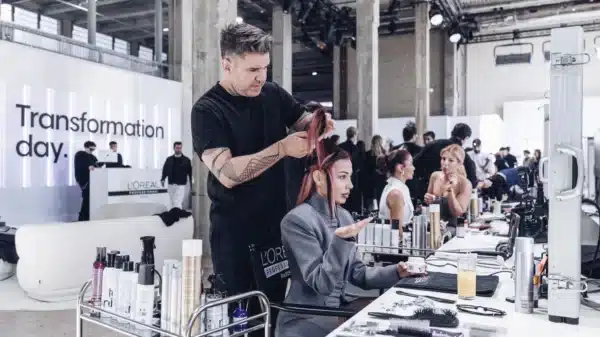
Hieronimus underlined the professional hair market continues accelerating from 2025, and that L’Oréal’s Professional Products division has been growing twice the speed of that. Its reported sales rose 19.1 percent in the quarter.
The group’s brands such as Kérastase, Redkin and Matrix are performing well in the category.
“Hair care is driving the growth,” Hieronimus said. “But the good news — and probably that’s one of the small differences compared to the beginning of the year — is that the salon market is a bit more positive.”
Because of the combined strength of the Professional Products division, the Consumer Products division and the Dermatological Beauty division, with its Dercos brand, “we have become the number-one hair care group in the world, from a number-three or number-two position like three years ago,” he said. “The combined efforts of these three divisions are really paying off.”
L’Oréal’s SalonCentric business, being developed particularly to serve independent stylists, registered around 8 percent growth.
“It has become the number-one distributor in America,” Hieronimus said, adding L’Oréal acquired a couple of small distributors in Canada, as well.
The executive said the fragrance market is globally growing by midsingle digits.
“We are on a run with our fragrances,” he said.
Year-to-date, L’Oréal’s perfume business is growing by close to double digits, fueled by an increasing number of blockbusters, such as Libre from Yves Saint Laurent that ranks first worldwide, Lancôme’s La Vie Est Belle, Prada Paradigme and Giorgio Armani I Will.

Prada Paradigme
Courtesy
“I’m very happy with the performance of Creed, which is also growing double digits,” Hieronimus said. “It fills a gap in our premium-end fragrances.”
He described the fragrance market as being dynamic everywhere, even if it slowed down slightly during the summer due to the heat.
“We sold a lot of sun care and a bit less fragrance,” Hieronimus said. “But we are now ready for a great holiday season.”
Helping to accelerate L’Oréal’s skin care business have been brands including Mixa that’s rolling out in Europe; Dr.G, which is the number-one skin care brand in South Korea, and Garnier and Thayers skin care that are strong in South Asia and the U.S., respectively.
“Our skin care is a bit more regional, except Garnier and L’Oréal Paris,” Hieronimus said. “But these three brands — Mixa, Dr.G and Thayers — are a good combination to try to win and to win in skin care. We have globally accelerated a lot, thanks to the great performance of LDB [or L’Oréal Dermatological Beauty], which is firing on all its engines.”
That is true at all price points, from CeraVe to La Roche-Posay and SkinCeuticals — they are all growing strongly.
When asked about K-beauty, Hieronimus said: “The boom is real.”
He called L’Oréal the “worldwide king of cushions,” referring to the portable beauty product-infused sponges held in compacts.
“The YSL cushion is a smashing hit in the U.S., which is interesting, because the West was not so far interested in cushions,” Hieronimus said.
L’Oréal in September signed with Cosmax, the South Korean research, development and manufacturing company, a memorandum of understanding to collaborate on next-generation beauty innovations.
K-beauty is growing in skin care, which is innovative, affordable and fast-growing, according to Hieronimus, who explained that is by about 30 percent on average.
However, K-beauty is still a small part of the overall skin care market.
“Globally, it is probably all brands put together 3 percent to 4 percent,” he said. “But it is a phenomenon, and that’s why we acquired two Korean brands.”
There’s 3CE Stylenanda — which is the top-ranked Korean makeup brand worldwide that is being rolled out in Southeast Asia — and Dr.G.
Dr.G’s rollout so far has been progressive from East to West, but thanks to the K-beauty wave, Hieronimus has asked the brand’s team to gear up and move faster, as it is a game of speed.
“That’s why if you are in the U.S. today, you would see Dr.G on TikTok Shop,” Hieronimus said. “The big play is to see whether we can also surf on that Korean wave in the West, and that’s one of the objectives of Dr.G.”
In the third quarter, L’Oréal posted growth in all its divisions and regions — with the exception of Latin America — led by Europe, with sales up 13.2 percent on a reported basis, and the South Asia-Pacific, Middle East, North Africa and Sub-Saharan Africa, or SAPMENA-SSA, zone.
SAPMENA has remained dynamic, with sales rising 21 percent.
“We’ve really gained share there,” where L’Oréal is growing between 1.6- and 1.7-times the market, outperforming across all divisions, Hieronimus said.
Business in Vietnam has been good, it’s accelerated in Thailand, while there’s been a turnaround in Indonesia, where L’Oréal is now competitive on social platforms, allowing for significant growth pick-up.
“We create for India much more than we did before,” he said, adding L’Oréal is accelerating e-commerce in the country with a focus on “quick commerce,” which speedily fulfils online orders.
“The market has been a bit better than what we hoped in the Middle East, despite the crisis,” Hieronimus said.
Meanwhile, he described Latin America as a “tale of two cities, because we are flying in Brazil, where L’Oréal is growing by double digits, two-and-a-half-times faster than the market.”
“Mexico was frankly a perfect storm,” Hieronimus explained. That’s because the market has softened to midsingle-digit growth, plus there were major inventory issues for makeup and commercial issues for L’Oréal.
“I don’t foresee a major improvement in Mexico in Q4, because these things take a little bit of time to fix,” he said. “But it will be, I think, a good momentum for 2027.”
In North Asia, L’Oréal’s business is mainly in China, comprising more than two-thirds of the activity, and in travel retail.
“In China, even though the market slowed down a tiny bit in Q3 — it remained dynamic at nine months at somewhere between 2 and 3 [percent] — we maintained our growth rate,” Hieronimus said. That was bolstered by the fact premium beauty is the most dynamic beauty segment in the Chinese market.
“At nine months, the luxury market is midsingle digits,” he added, of China. “The dermatological beauty market is a bit higher than that, and professional is midsingle digits. The only part that remains flattish is mass. That’s favoring us.”
L’Oréal’s most premium brands, such as Helena Rubenstin, SkinCeuticals and Kérastase drive growth there.
“We have been outperforming the market in sellout,” Hieronimus said.
The group’s travel retail activity returned to positive growth in the third quarter. L’Oréal’s business on the duty-free Chinese island of Hainan was very positive, yet it remained slightly negative in Mainland China.
“But that’s probably one of the things that you won’t see in Q4,” he said, referring to the turbulence in Chinese domestic airports due to changes in operators that led to stock issues, which is being resolved.
“We had to re-pipe them with a little bit of inventory,” Hieronimus said.
In the third quarter, L’Oréal e-commerce sales rose by approximately 17 percent, which the company said was well ahead of the online market. The group is doubling down on that channel with strong results seen across all regions, especially in emerging countries.
In the first nine months of this year, L’Oréal sales reached 35.34 billion euros, up 7.7 percent on a reported basis. In both like-for-like and adjusted like-for-like terms, sales grew 6.9 percent in the period.
“Regarding the rest of the year, we expect the beauty market to grow around plus 5 percent, and we will continue to outperform — albeit at a slightly more moderate rate,” Hieronimus said. “So we will deliver on a full-year basis the promised acceleration of our top-line growth versus last year significantly.”