













The fashion and luxury industry faces significant hurdles today, particularly with the pressing issue of generational renewal that shadows the sector known for its exquisite Italian craftsmanship. In response, the Prada Group has made a bold commitment to nurturing new talent.
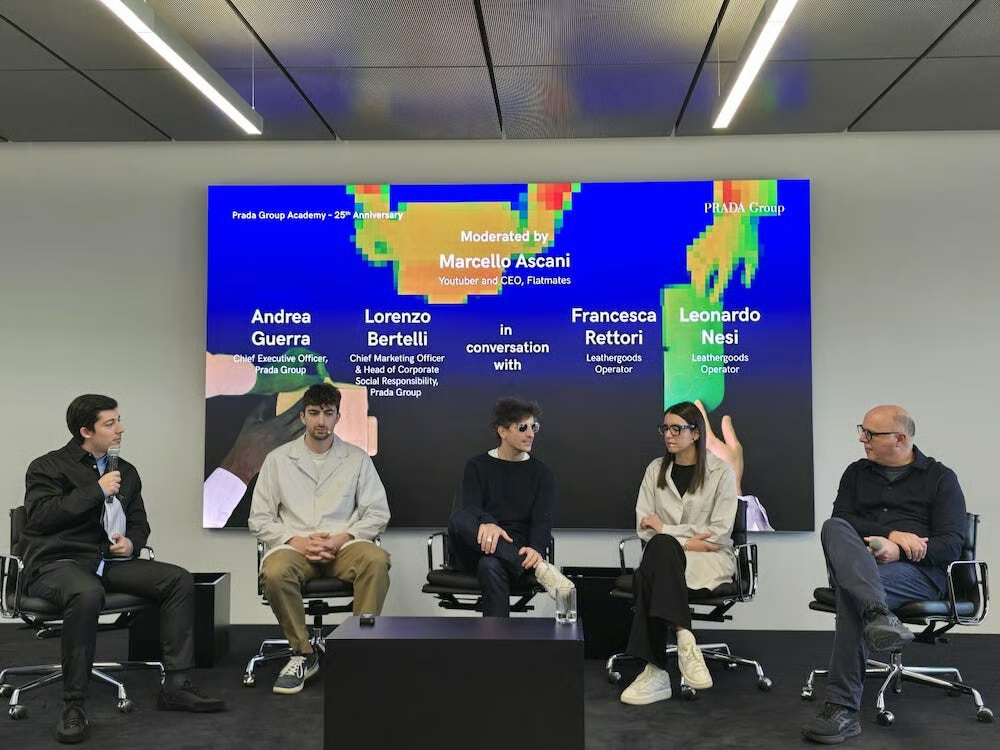
Celebrating the 25th anniversary of the Prada Group Academy, the company welcomed guests at its Scandicci site to showcase the vibrant activities occurring at this training hub. This event allowed attendees, including representatives from FashionNetwork.com, to engage in meaningful discussions alongside CEO Andrea Guerra and Lorenzo Bertelli regarding the necessity of attracting younger generations to preserve the rich tradition of Italian craftsmanship.
The occasion was graced by Claudia Sereni, Mayor of Scandicci, who emphasized the critical partnership between local institutions and businesses.
“Scandicci is not just a home for prestigious brands; it is also a cradle for subcontractors—the skilled artisans who bring products to life. We are currently witnessing a serious industrial crisis. Markets undergo natural cycles, yet the challenge remains daunting for the entire supply chain to find ways to rejuvenate. In such a context, training becomes even more vital; we need young talents who can adapt to the evolving demands of companies and shape innovative projects,” Sereni remarked.
“Our goal is to build stronger ties with brands, collaborating on their training initiatives. We seek ways to highlight the cultural significance of leather goods, fostering that appreciation among both locals and visitors. Our ambitious aim is to establish a Museum of Accessories that showcases the value of craftsmanship, potentially constructed atop a unique roof garden above an underpass of the A1 motorway—a space that could connect the city with its manufacturing roots.”
As the conversation shifted to the pressing issue of generational transition, the statistics painted a stark picture: by 2028, the industry will require over 270,000 specialized manufacturing professionals, including 75,000 within the luxury sector, while current supply will meet only 50 percent of that need.
However, Guerra remains optimistic: “Many associate manufacturing with assembly lines, repetitive tasks, but that’s not the full story. What we practice is industrial craftsmanship—where 80 percent of the work involves skillful hands, creative minds, and passionate hearts. Here in Scandicci, we work with leather, a living material with unique characteristics that require meticulous attention during processing; without that expertise, we could not produce our exceptional goods,” the CEO emphasized. “Moreover, it is crucial to remember that luxury requires time—a meticulous journey developed over years. There can be no rush; otherwise, we’d be making something entirely different.”
“I am not concerned about the upcoming generational shift because, particularly post-Covid, I notice a growing desire in young people for balanced lives, less alienation, and genuine connections. While salary is significant, it isn’t their only concern. Creating a workplace that’s enjoyable, investing in continuous learning, and addressing welfare issues—like promoting women’s employment—is vital, especially since a large part of our workforce is female,” Guerra added.
Regarding attracting youth to manual trades often overlooked, Bertelli stated: “Today, the allure of ‘white-collar jobs’ is diminishing. Many tasks previously confined to office spaces are now efficiently handled by technology. However, no machine can replicate the skill of a craftsperson—the invaluable knowledge and expertise honed over years of fervent work. We must convey this to the younger generation. Those mastering a craft should view new technologies—like artificial intelligence—not as threats but as tools to enhance their contributions in manufacturing,” the entrepreneur emphasized.
The communication surrounding this transition is crucial, making today’s crafts feel relevant and contemporary. It’s thrilling to realize that with one’s hands, one can create objects that are unparalleled by any machine.
Rosa Santamaria Maurizio, chief people officer of the Prada Group, highlighted the significance of prioritizing people and emotions within the company.
“We integrate these principles at the core of our operations, welcoming future employees to experience our production sites and stores firsthand, allowing them to truly grasp our work culture. We are actively training our team leaders on these foundational values,” the manager clarified.
“Furthermore, diversity and inclusion—notably equal opportunities for everyone—are paramount to us, and we are on the path to achieving gender equality certification. The ‘Drivers of Change’ initiative, championed by Lorenzo Bertelli, allows employees to propose initiatives they believe in, which the company actively considers for implementation, e.g., inviting family members to explore our work environments and witness our vibrant atmosphere. The Academy plays a key role in fostering intergenerational exchanges between master artisans and apprentices, yielding mutual benefits.”
During the conference, two Academy students, Leonardo and Francesca, were directly addressed by Guerra, who concluded his speech with meaningful guidance for all young people: “Here’s the same advice I offer my children regarding the professional world: maintain humility while striving to challenge the status quo. Be humble enough to arrive early or to put in extra hours if needed. But be challenging in your desire for a prosperous future; don’t hesitate to inquire and demand legitimate answers. This determination can enrich your future,” the CEO stated. “And to our master artisans, a heartfelt thank you for your willingness and commitment to passing on your vast knowledge and skills.”
Prada Group Academy: by the numbers
The Prada Group Academy, with locations in Tuscany, Marche, Veneto, and Umbria, educates around twenty young individuals per session, with 70 percent securing employment within the group thereafter. From 2021, when courses resumed post-Covid, to 2024, 29 courses have been conducted covering Leather Goods, Footwear, and Apparel, increasing from 3 in 2021 to 11 in 2024.
Since 2021, a total of 571 trainees from 18 different nationalities have completed training, with a gender distribution of 69.7 percent women and 30.3 percent men. In 2024 alone, 120 young graduates saw 82 hired by the group.
This year marks the initiation of seven training programs across three categories, with 78 trainees already trained as of November 2025. Currently, three Academy programs are underway in Leather Goods and Apparel, totaling 152 confirmed participants—an increase of 28 percent from 2024. In September, a new men’s footwear course commenced in Montegranaro, while a new session in Torgiano for technical knitwear roles began last October.