














This February, Faguo, a French brand dedicated to sustainable clothing, is set to release a collection featuring several thousand T-shirts and a sweatshirt, all crafted by Losanje. This innovative company specializes in the industrialization of upcycling, turning discarded materials into fashionable items.

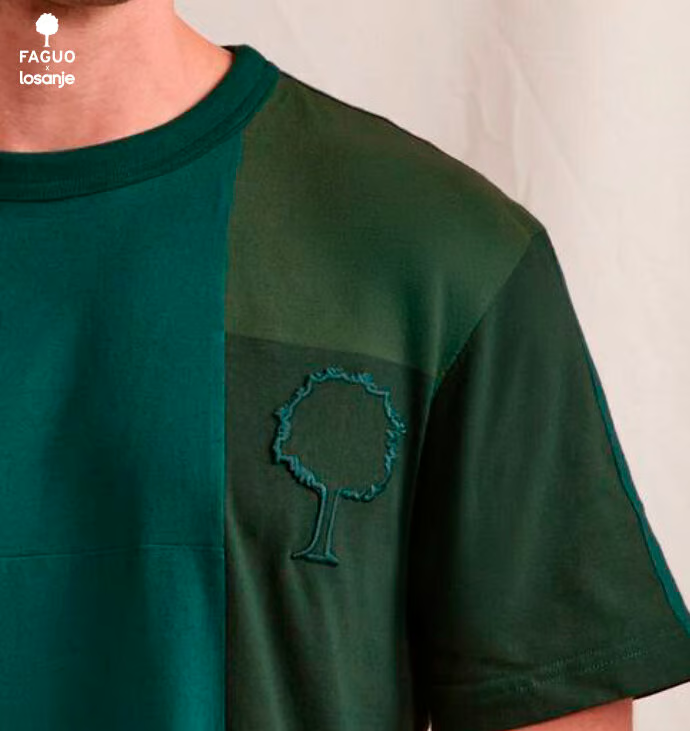
The collection includes Lugny T-shirts, emblazoned with the signature tree logo, and the cozy Dirac hooded sweatshirt. The T-shirts, available in blue and dark green, retail for €60 each, while the sweatshirt, also in blue, is priced at €105. Each of these items is handcrafted from garments sourced from sorting centers across France and Europe, then carefully cut and stitched by Faguo’s dedicated teams.
“Selecting our most iconic pieces for this collaboration was essential to reshape the narrative around upcycling,” explains Anaïs Barry, marketing and communications director at Losanje. “Our goal is to provide clothing options with minimal environmental consequences. By upcycling, we manage to decrease that impact by an additional 90% compared to a standard Faguo garment. However, we also believe these pieces have their own intrinsic appeal as high-quality products.”
For Losanje, this venture represents a significant opportunity. The company aims to establish upcycling as a credible industrial alternative to conventional clothing production. According to Simon Peyronnaud, president and co-founder of Losanje, this could mark a groundbreaking moment in the industry with the launch of Europe’s first fully upcycled collection comprising thousands of unique pieces.
“Previously, we’ve launched limited collections in collaboration with brands like Miu Miu and Marine Serre, which included only dozens or hundreds of pieces,” Peyronnaud continues. “This time, it’s about genuine scalability. This collaboration has been a highly educational experience, reinforcing our belief that we can source materials locally instead of relying on cotton from distant fields.”
Over the past five years, Losanje claims to have successfully upcycled over 320 tonnes of textiles through partnerships with entities such as SNCF, La Poste, the Comité Paris 2024, and Roland-Garros. To facilitate its ambitious growth plans, the company has recently launched a new manufacturing facility in Nevers, situated in the Nièvre department.
“We are transitioning from a compact 700-square-meter workshop to an expansive 2,500-square-meter factory, specifically designed to elevate our capabilities,” says Simon Peyronnaud, whose team now consists of 25 employees. He hints at several exciting collaborations in the pipeline, with brands eager to explore upcycled fashion options.